Why Custom E-Commerce Development Is a Strategic Investment
01
No Growth Ceiling:
by building on an architecture that scales with your catalog, traffic, and business logic.
02
No Logic Limits:
by implementing the business rules, pricing, or workflows your business needs.
03
No Platform License Costs:
by owning your code and platform outright, with no recurring license or gradually increasing subscription fees and mandatory plugin updates.
04
Faster Pages, Higher Conversions:
by engineering for your UX from the ground up, focusing on speed and ease of use.
05
Your Own Roadmap:
by deciding what gets built and when, according to your growing and changing business needs.
Custom E-Commerce Development Process
01
Strategy, Discovery & Planning
Intense close-cooperation workshops covering your business needs, customers and expected goals. Assessment of the technical architecture and integration with your ERP, payment, loyalty, logistics and other existing systems. A preliminary roadmap of timelines, costs and priorities is developed.
UX planning and UI design according to your brand book. A clickable prototype covering the main features is developed and ready for review.
Front-end, back-end, integrations, content, and quality assurance.
Your platform ships to production. Full documentation is provided to facilitate maintenance and changes that can be done in-house.
SLA, maintenance, analytics, and new features according to your business goals and customer needs.
Frequently Asked Questions
Do You Need a Custom E-Commerce Platform?
You don’t need a custom-built e-commerce platform if a smaller, generic platform (Shopify, WooCommerce and others) suits your business needs – that is often a cheaper solution that can be implemented in-house, and often a sensible first step if you are trying out digital sales. However, for a larger company a custom-built platform that integrates well with the existing payment, loyalty and logistics systems is often the right choice. If you are considering a large and expensive pre-built platform, like Adobe Commerce (Magento), a custom-built platform might be a more sensible solution.
When Is the Right Time to Upgrade Your E-Commerce Platform?
You should consider migrating to a custom-built e-commerce platform if your current platform 1) is getting more expensive to run due to licensing or support fees 2) does not support your business needs, requiring cumbersome workarounds 3) is slow, unintuitive, or frequently suffers from various glitches. In short, if your current platform is slowing your business down, limiting sales and decreasing customer satisfaction, a custom-built platform might be your next step towards your business goals.
Can I migrate from my existing platform without interrupting sales?
Yes! Migrations from Shopify, WooCommerce, Adobe Commerce (Magento), or other platforms, including custom-built ones, typically start with a technical audit of your current catalog, integrations, and data, so we can plan a migration that doesn't interrupt sales.
Why Choose Custom Architecture Over Expensive Off-the-Shelf Platforms (Like Adobe Commerce)?
Off-the-shelf platforms are relatively easy to implement at the start. Often, they are quite enough for your business needs. However, many businesses face plugin limitations and performance issues as their business develops. Some platforms have licensing that scales with the revenue, increasing the costs as your business grows. In these cases, it is worth considering a custom e-commerce platform that is built around your product catalog, processes, and growth plans.
What if my needs grow and change over time?
A major benefit of a proprietary platform built around your business needs is that many potential changes have already been factored in its architecture. Our aim is to create platforms that are easy to upgrade and integrate with other systems. Your platform will be owned by you, and its maintenance can be done by any skilled developer. We provide you with customer support and opportunities to improve your platform according to your needs, but if your company has an IT department, it is fully possible for you to maintain and upgrade the platform in-house.
How long does it take to launch a custom e-commerce platform?
It depends on scope, but most projects follow the same phases: Discovery (about a month), Integration Analysis and UX/UI Design (1–3 months), and first-stage development (3 months or more). Most clients launch a first stage, then expand.
Can You Integrate the New Platform with Our Current Business Systems?
Yes!
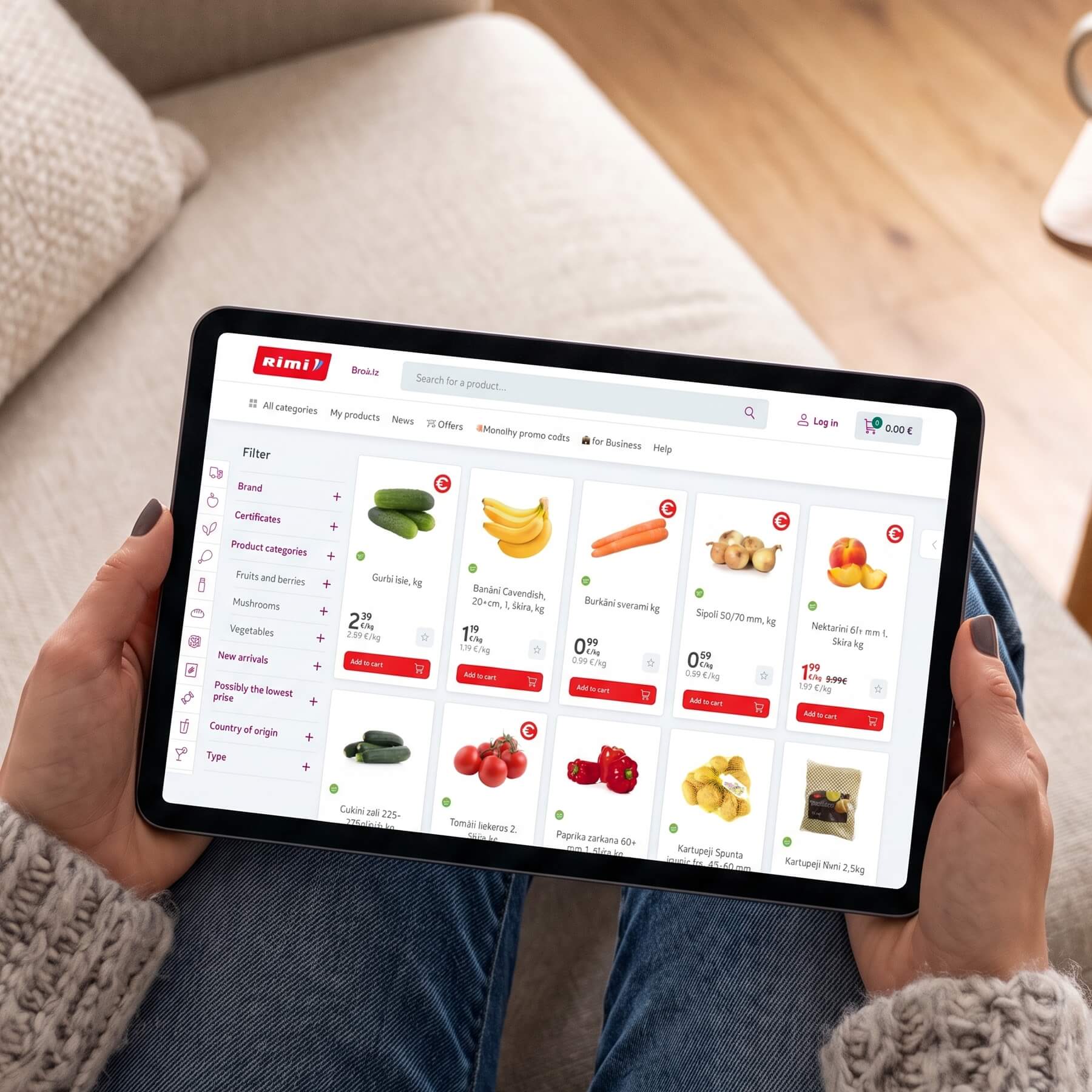
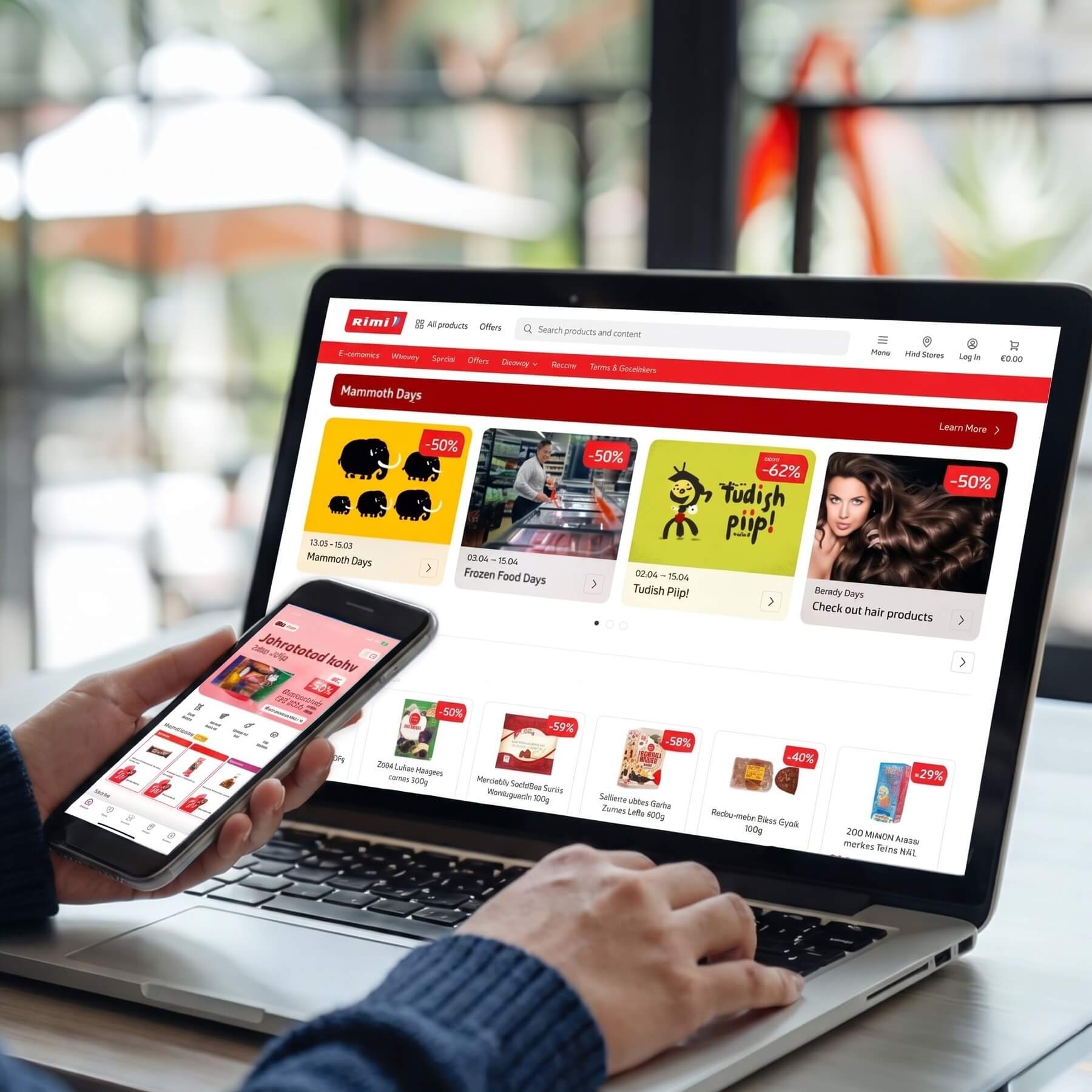
Rimi platform, for example, integrates 100+ APIs, including SAP Hybris Commerce and a loyalty membership system, while serving three different Baltic markets from one flexible architecture.
Can the System Handle High Traffic and Large Data Volumes?
Yes!
Rimi platform manages 10 000+ products and 700 000+ registered users on infrastructure we planned specifically for that scale.